01 / Clinical AI · Evaluation
GovBench-Clinical
A benchmark and clinician workbench that measures what each safety layer in a multi-agent clinical AI pipeline actually changes.
The problem
Clinical AI systems stack up safety layers such as verifiers, validators and reviewers, and assume each one helps. Very few measure whether a layer changes the answer at all.
What I built
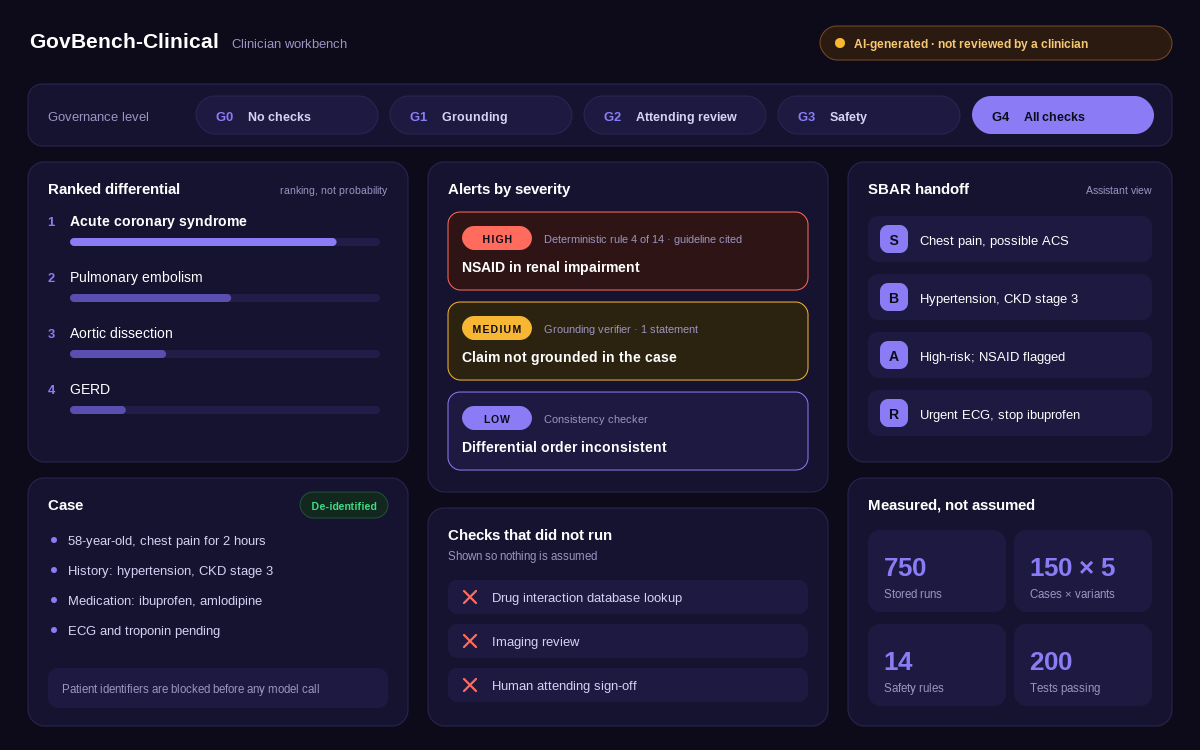
- Five governance levels, G0 to G4, run on identical inputs so each layer's effect can be isolated.
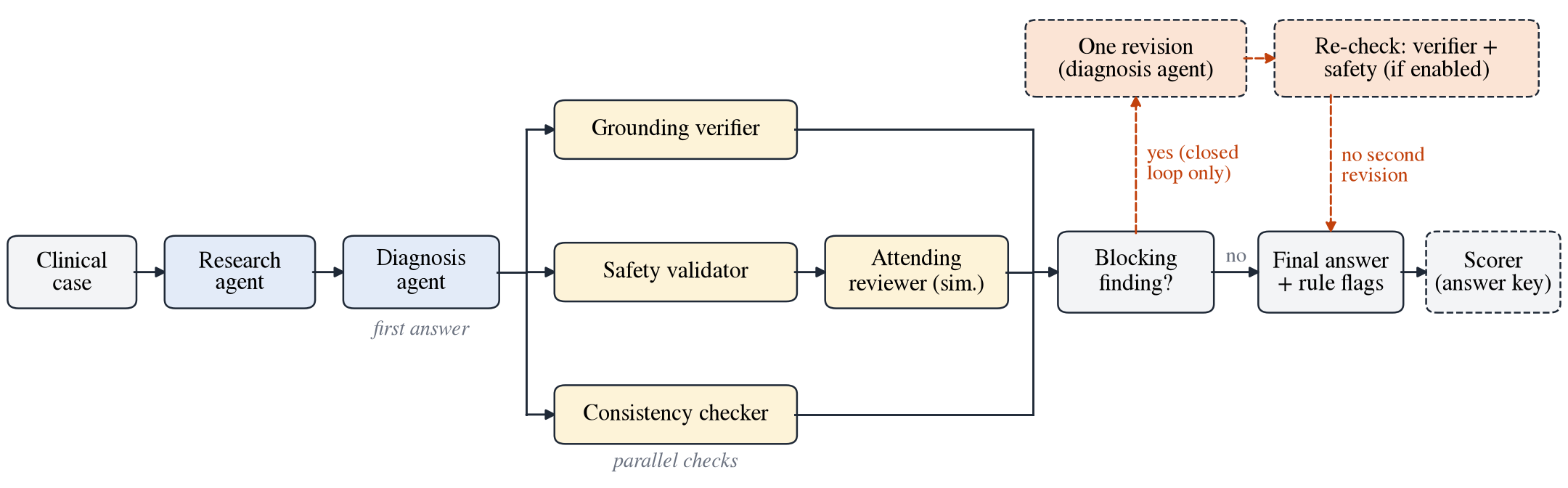
- A closed loop: serious concerns send the diagnosis back for one revision instead of only annotating it.
- 14 deterministic contraindication rules that run on every case, independent of the model, each with its guideline source.
- A clinician-facing view that groups alerts by severity and lists the checks that did not run.
- A blinded clinician rating tool that produces the human validation data the benchmark needs.
- Safety by default: identifiable patient data is blocked before any model call, with a prompt-injection guard.
In numbers
750stored runs: 150 cases × 5 variants
14deterministic safety rules
200automated tests passing
2.7%of cases where governance changed the diagnosis
What the measurements showed
Does governance change the diagnosis?Rarely. The primary diagnosis differs from the baseline in at most 2.7% of cases.
Do the alerts identify wrong diagnoses?Not yet. Each signal detects misdiagnosis at AUROC 0.40 to 0.56, where 0.5 is chance.
How accurate is the pipeline?0.29 overall, after correcting a substring-matching scorer that had reported 0.74.
Does closing the loop help?No. Accuracy was 43.0% with no checks and 37.3% with all checks feeding back a revision.
What does governance cost?Latency rises from 45 s to 111 s per case, and tokens from about 3,100 to 8,400.
How it works
Takeaway
The point of this project is that it reports what it measured, including the results that don't flatter the system. That honesty is what makes a benchmark useful.
Next project